Posted On: Jul 9, 2026
Author: Jason H.
insurance budgeting risk-management
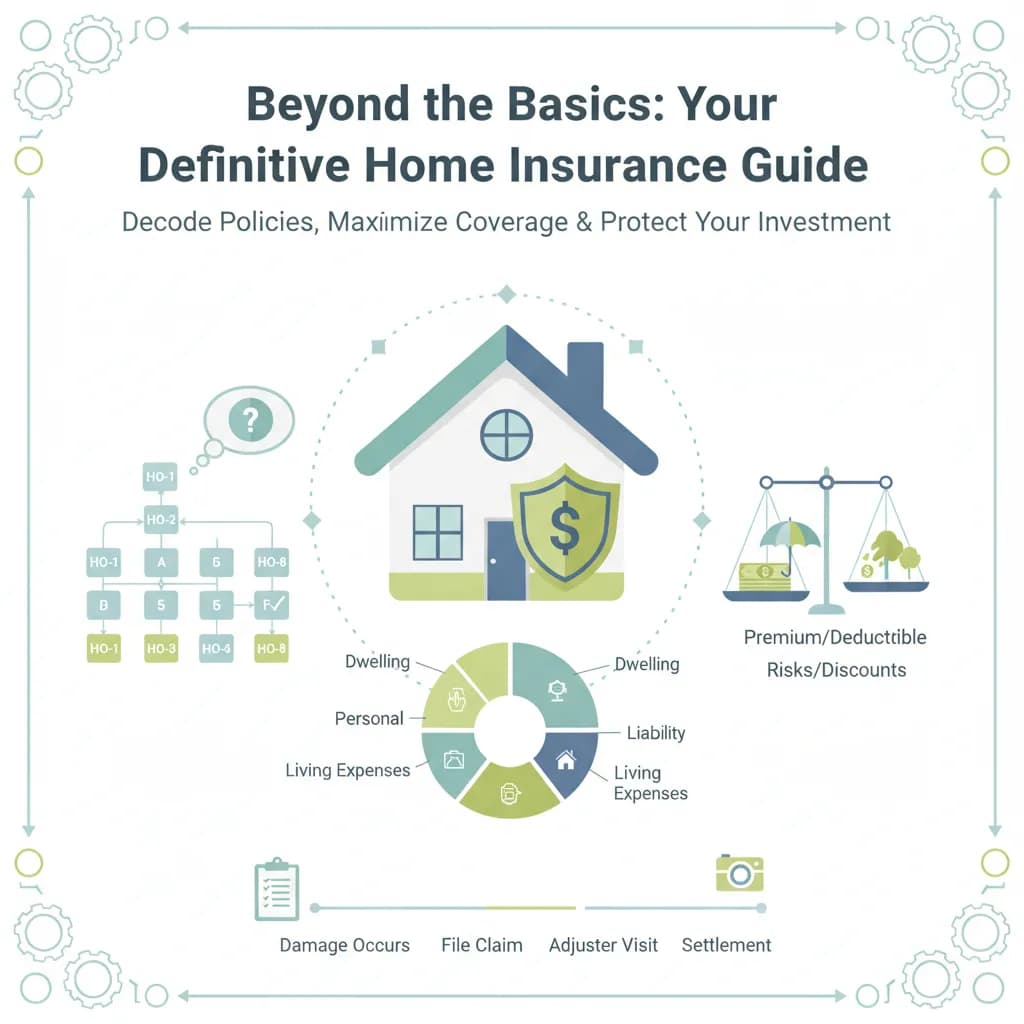
For a first-time homeowner, the stack of documents at closing can feel overwhelming. Buried in that stack is one of the most important, yet least understood, documents you'll ever sign: your homeowner's insurance policy. It’s easy to treat it as just another box to check for your mortgage lender, but this policy is your single greatest financial shield against disaster. It protects not just the physical structure you live in, but your belongings, your savings, and your peace of mind.
But what does it actually cover? Are you protected if a pipe bursts? What about a tree falling in the backyard? What’s the difference between “replacement cost” and “actual cash value”? Answering these questions before you need to file a claim is one of the smartest things you can do as a homeowner. This guide will demystify the jargon, explain the coverage, and give you the confidence to ensure your biggest investment is properly protected.
Homeowner's insurance is a package policy that combines various personal insurance protections, offering financial reimbursement to the owner of a home and its contents in case of damage or theft, and to other people for liability in case of accidents on the property. While not legally mandated by the state, nearly all mortgage lenders require you to carry a policy to protect their investment until your loan is paid off. Think of it as a contract between you and an insurance company. You pay a regular fee (the premium), and in return, the company agrees to pay for covered losses as outlined in your policy, helping you recover from unexpected events without devastating your finances.
A standard homeowner's insurance policy typically provides four essential types of coverage: coverage for the structure of your home, coverage for your personal belongings, liability protection, and coverage for additional living expenses if you're temporarily unable to live in your home due to an insured disaster. These are often referred to as Coverage A, C, E, and D, respectively, with additional coverages for other structures (B) and medical payments (F). This bundled approach ensures you are protected from multiple angles, from a fire that damages your kitchen to a visitor who slips on your icy walkway. Each piece of coverage has its own limits and conditions, which is why understanding the details is so critical.
Not all home insurance policies are created equal; they come in different forms, labeled HO-1 through HO-8, each offering a different level of protection. The type of policy you need depends on the type of home you own (a single-family house, a condo, or a mobile home) and the level of risk you're willing to accept. The most common policies for single-family homes are HO-3 and HO-5, but understanding the whole range helps you appreciate the coverage you're buying.
The different types of homeowner's insurance policies offer varying levels of protection against specific lists of perils, from basic coverage for a few named events (HO-1) to comprehensive, open-peril coverage for almost everything except a few specific exclusions (HO-5). The policies are standardized across the industry to make comparison easier. For example, HO-3 is the most common policy sold today, providing a solid balance of broad protection for your home's structure and named-peril coverage for your personal belongings.
An HO-1 policy is the most basic, bare-bones home insurance available, covering your property against only 10 specific, named perils. These perils typically include fire or lightning, windstorm or hail, explosion, riot or civil commotion, aircraft, vehicles, smoke, vandalism, theft, and volcanic eruption. Because its coverage is so limited and excludes common risks like falling objects or water damage from plumbing, most insurers no longer offer HO-1 policies, and they don't meet the requirements of most mortgage lenders.
An HO-2 policy expands on the basic form by covering the 10 perils from HO-1 plus six additional ones, bringing the total to 16 named perils. The extra protections typically include falling objects; the weight of ice, snow, or sleet; accidental discharge or overflow of water or steam; sudden and accidental tearing apart, cracking, burning, or bulging of a home system; freezing of home systems; and sudden and accidental damage from an artificially generated electrical current. While better than HO-1, it is still a “named-peril” policy, meaning if the cause of damage isn’t on the list, you’re not covered.
The HO-3 policy is the most popular type of homeowner's insurance in the United States, offering a great combination of coverage and affordability. It provides “open-peril” coverage for your home's structure, meaning it's protected from all perils except those specifically excluded in the policy (like floods or earthquakes). However, your personal belongings are covered on a “named-peril” basis, typically the same 16 perils listed in an HO-2 policy. This hybrid approach gives you robust protection for your biggest asset—the house itself—while keeping premiums manageable.
An HO-5 policy offers the most extensive coverage for single-family homes, providing open-peril protection for both your dwelling and your personal property. This means that unless a peril is explicitly excluded in the policy, any damage to your home or your belongings is covered. HO-5 policies also often include higher coverage limits for valuable items like jewelry and electronics and typically provide replacement cost value for your belongings, not the depreciated actual cash value. It's the premium option for homeowners who want maximum protection and are willing to pay a higher premium for it.
These policies are designed for specific living situations beyond the typical single-family home. An HO-4 policy is for renters and covers personal property and liability, but not the building itself. An HO-6 policy is for condo owners, covering their personal belongings and the interior of their unit from the walls in. An HO-7 policy is similar to an HO-3 but is specifically designed for mobile or manufactured homes. Finally, an HO-8 policy is used for older homes, particularly registered landmarks or architectural marvels, where the replacement cost would be astronomically higher than the market value. It provides basic, named-peril coverage and often pays for repairs using common, modern materials rather than historically-accurate ones.
| Feature | HO-3 (Special Form) | HO-5 (Comprehensive Form) | | :--- | :--- | :--- | | Dwelling Coverage | Open-Peril (all perils covered except exclusions) | Open-Peril (all perils covered except exclusions) | | Personal Property Coverage | Named-Peril (only the 16 listed perils are covered) | Open-Peril (all perils covered except exclusions) | | Personal Property Payout | Typically Actual Cash Value (ACV) unless upgraded | Typically Replacement Cost Value (RCV) by default | | Typical Cost | Lower premium | 10-20% higher premium than HO-3 | | Best For | The average homeowner seeking a great balance of protection and cost. | Homeowners with high-value personal property who want the broadest protection available. |
Every standard home insurance policy is built on a foundation of several key coverage types. Understanding what each part does, how its limits are set, and where the potential gaps are is fundamental to being an empowered homeowner. These coverages are usually labeled A through F in your policy documents.
Dwelling coverage, or Coverage A, is the part of your policy that pays to repair or rebuild the physical structure of your house if it's damaged by a covered peril. This includes the foundation, roof, walls, and built-in appliances like your furnace and water heater. It also covers attached structures, such as a garage or a deck. The amount of dwelling coverage you have is the cornerstone of your policy, as it determines the maximum amount your insurer will pay to restore your home. Getting this number right is arguably the most important step in buying home insurance.
You calculate the right amount of dwelling coverage by determining the home's replacement cost, which is the estimated cost to rebuild your home from scratch with similar materials at today's prices. This is not the same as your home's market value, purchase price, or tax assessment. To find your replacement cost, you can hire a professional appraiser, use your insurance company's calculation tool (which factors in local labor costs, materials, and your home's unique features like square footage and style), or use the rule-of-thumb of multiplying your home's square footage by the local per-square-foot construction costs. Always insure for 100% of the estimated replacement cost to avoid being underinsured.
Other Structures coverage, or Coverage B, pays for damage to structures on your property that are not attached to your main house. This includes things like a detached garage, a shed, a fence, a swimming pool, or a guesthouse. This coverage is typically set as a percentage of your dwelling coverage, most commonly 10%. So, if your home is insured for $400,000, you would automatically have $40,000 in coverage for your other structures. If you have particularly valuable structures on your property, like a large workshop or a high-end guesthouse, you can often purchase additional coverage.
Personal property coverage, or Coverage C, reimburses you for the loss or damage of your belongings if they are stolen or destroyed by a covered peril. This includes everything inside your home that isn't nailed down—furniture, electronics, clothing, kitchenware, and so on. Coverage extends to your belongings even when they are outside your home, like a laptop stolen from your car. This coverage is usually calculated as a percentage of your dwelling coverage, typically between 50% and 70%. It's crucial to create a home inventory to prove what you owned and its value in the event of a total loss.
You should choose Replacement Cost Value (RCV) coverage for your personal property whenever possible, as it pays to replace your lost items with new, similar items at today's prices. In contrast, Actual Cash Value (ACV) only pays you for the depreciated value of your items at the time of the loss. For example, if your 5-year-old sofa is destroyed in a fire, RCV coverage would give you enough money to buy a new, comparable sofa. ACV would only give you what that 5-year-old sofa was worth, which is significantly less. While RCV coverage comes with a slightly higher premium, it provides far superior protection and is a highly recommended upgrade.
Additional Living Expenses (ALE) coverage, or Coverage D, pays for the extra costs you incur if you cannot live in your home due to damage from a covered peril. These expenses include the cost of a hotel or rental home, restaurant meals, laundry, and other necessary living costs that exceed your normal budget. For example, if you normally spend $600 a month on groceries but now have to spend $1,200 on restaurant meals, ALE would cover the $600 difference. This coverage is a financial lifeline during a stressful time, allowing you to maintain your standard of living while your home is being repaired. It is typically set at 20% to 30% of your dwelling coverage.
Personal liability coverage, or Coverage E, protects your assets by paying for legal and medical expenses if someone is injured on your property and you are found to be at fault. This coverage also applies to certain incidents that happen off your property, such as if your dog bites someone at the park or you accidentally injure someone while playing golf. A standard policy typically includes $100,000 to $300,000 in liability protection, but experts often recommend at least $300,000 to $500,000. If your net worth is higher, you should consider purchasing a separate umbrella policy for additional protection.
Medical payments to others coverage, or Coverage F, pays for minor medical bills for a guest who is injured on your property, regardless of who is at fault. This is designed to be a goodwill coverage that can prevent a small accident from escalating into a major liability lawsuit. For instance, if a friend trips over a toy and sprains their ankle, this coverage could pay for their X-ray and doctor's visit. Coverage limits are typically low, ranging from $1,000 to $5,000 per person, but it's a valuable feature for handling small incidents quickly and amicably.
One of the most dangerous assumptions a homeowner can make is that their insurance policy covers everything. In reality, all policies have a list of specific exclusions—perils and circumstances that are not covered. Knowing these exclusions is just as important as knowing what is covered, as it allows you to identify gaps in your protection and purchase separate policies or riders if needed.
Common exclusions in a standard home insurance policy include damage from floods, earthquakes, sewer backups, neglect or poor maintenance, war, and nuclear hazards. Standard policies also do not cover pest infestations (like termites), mold damage that isn't the result of a covered peril, or damage from settling or shifting foundations. For catastrophic events like floods and earthquakes, you must purchase separate insurance policies. For other risks, like sewer backup, you can often add an endorsement to your existing policy for an additional fee. This is why reading your policy documents carefully is not just a suggestion—it's a necessity for responsible homeownership.
No two homes or homeowners are exactly alike, which is why insurance policies can be customized with add-ons called riders or endorsements. These are amendments to your standard policy that provide additional coverage for specific risks or high-value items, allowing you to fill the gaps left by standard exclusions.
A home insurance rider or endorsement is an addition to your standard policy that changes or expands your coverage for an extra premium. Think of it as a la carte insurance. If your basic policy doesn't cover a specific risk you're concerned about (like a sewer backup) or doesn't provide enough coverage for certain valuables (like an expensive engagement ring), you can purchase a rider to add that specific protection. This is a cost-effective way to create a policy that perfectly matches your individual needs.
You almost certainly need separate flood insurance if you want protection from flood damage, as it is excluded from virtually all standard homeowner's policies. Even if you don't live in a high-risk flood zone, it's a smart purchase, as more than 20% of flood claims come from properties outside of designated high-risk areas, according to FEMA. Flooding can be caused by heavy rainfall, overflowing rivers, storm surges, and rapid snowmelt. You can purchase flood insurance through the federally managed National Flood Insurance Program (NFIP) or from some private insurers.
You need to purchase a separate earthquake insurance policy if you want coverage for damage caused by ground shaking. Similar to flooding, earthquakes are a standard exclusion on homeowner's policies. If you live in a region with seismic activity, such as California, Alaska, or the Pacific Northwest, this coverage is essential. The cost and deductible for earthquake insurance can be high, but they are a fraction of the cost to rebuild your home out-of-pocket after a major quake.
A scheduled personal property endorsement is a rider that provides broader, more specific coverage for high-value items that exceed the sub-limits in your standard policy. Standard policies often cap the payout for categories like jewelry, firearms, or fine art at around $1,500. If you own a $10,000 engagement ring, you would need to “schedule” it with this endorsement to insure it for its full appraised value. This rider often provides “open-peril” coverage for the item and may not require a deductible for a claim.
Water backup and sump pump overflow coverage is a crucial endorsement that covers damage caused by water backing up through sewers or drains, or from a failed sump pump. This is a surprisingly common and costly event that is specifically excluded from standard home insurance policies. A few inches of water in a finished basement can easily cause tens of thousands of dollars in damage. This rider is typically inexpensive—often just $50 to $100 per year—and is one of the most valuable endorsements a homeowner can buy.
An ordinance or law coverage endorsement pays for the extra costs required to rebuild your home to meet current building codes after it has been damaged. Standard policies pay to rebuild your home as it was, but if your home is older, building codes may have changed significantly. This endorsement covers three things: the cost to demolish the undamaged parts of the home if required by code, the cost of rebuilding to the new, stricter code, and the increased cost of construction. Without it, you could face a significant out-of-pocket expense to bring your rebuilt home up to modern standards.
The price you pay for home insurance isn't arbitrary. It's the result of a complex calculation that assesses your home's specific risk profile. Understanding these factors can empower you to not only budget effectively but also take steps to lower your costs.
A home insurance premium is calculated based on a wide range of risk factors related to your property and your personal profile. Key property factors include the home's location (proximity to coastlines or fire stations), age, construction materials, condition of the roof, and claims history. Personal factors include your credit score, your personal claims history, and whether you own pets of a certain breed. The insurer weighs all these variables to predict the likelihood and potential cost of you filing a claim, and sets your premium accordingly. For example, a newer home with a new roof and a monitored security system will almost always be cheaper to insure than an older home with an aging roof and no security features.
A home insurance deductible is the amount of money you are responsible for paying out-of-pocket on a claim before the insurance company's coverage kicks in. For example, if you have a $1,000 deductible and a storm causes $10,000 in roof damage, you would pay the first $1,000, and your insurer would pay the remaining $9,000. Deductibles and premiums have an inverse relationship: choosing a higher deductible will lower your annual premium, while a lower deductible will result in a higher premium. A higher deductible can save you money year after year but means you need to have more cash readily available in an emergency.
You can get common home insurance discounts by bundling your home and auto policies, installing safety and security devices, and maintaining a good credit score. Most insurers offer a multi-policy discount, which is often one of the largest available. You can also earn discounts for having smoke detectors, fire extinguishers, deadbolt locks, a burglar alarm, or a sprinkler system. Other potential discounts include those for being claim-free for a certain number of years, being a non-smoker, or for having a newer or recently renovated home, especially with a new roof. It's always worth asking your insurance agent for a full review of available discounts.
Source: Based on 2023 data from Bankrate and Forbes Advisor for $250,000 in dwelling coverage. Costs are averages and can vary significantly based on individual factors.
| State | Average Annual Premium | State | Average Annual Premium | | :--- | :--- | :--- | :--- | | Oklahoma | $4,180 | New York | $1,390 | | Nebraska | $3,995 | California | $1,285 | | Kansas | $3,930 | Washington | $1,080 | | Texas | $3,650 | Arizona | $1,075 | | Florida | $2,580 | Pennsylvania | $990 | | Illinois | $1,670 | Ohio | $965 | | Georgia | $1,550 | Utah | $785 | | Michigan | $1,440 | Vermont | $730 | | Virginia | $1,410 | Oregon | $710 |
When disaster strikes, the last thing you want is to be confused about how to get the help you've been paying for. Knowing the claims process ahead of time can reduce stress and lead to a smoother, faster resolution.
Immediately after damage occurs to your home, your first priority is to ensure everyone is safe and then take steps to prevent further damage. This might mean shutting off the main water valve after a pipe bursts, or placing a tarp over a hole in the roof after a storm. Document the damage extensively by taking photos and videos from multiple angles before moving or cleaning anything, if it's safe to do so. These initial steps are crucial for both safety and for supporting your insurance claim.
You file a homeowner's insurance claim by contacting your insurer as soon as possible, providing them with your policy number and a detailed description of the incident. After this initial contact, you will be assigned a claims adjuster. You will need to fill out claim forms, provide your documentation of the damage (photos, videos, receipts), and create a list of damaged or lost property. The adjuster will schedule a visit to inspect the damage, after which they will assess the scope of the loss and determine the settlement amount based on your policy's coverage and deductible.
The role of a public adjuster is to advocate on your behalf, the homeowner, to negotiate a fair settlement with your insurance company. While the claims adjuster sent by your insurer works for the insurance company, a public adjuster works for you. They are experts in understanding policy language and documenting claims to maximize your payout. They are typically hired for large, complex claims and work on a commission basis, taking a percentage of the final settlement. For a major loss, their expertise can be invaluable in ensuring you receive all the compensation you are entitled to.
Your relationship with your insurance policy shouldn't be a “set it and forget it” affair. A proactive approach not only ensures you have the right coverage but can also save you money and headaches in the long run.
You should review your home insurance policy at least once a year, or whenever you have a major life event or make a significant change to your home. An annual review ensures your coverage limits, especially dwelling coverage, are keeping up with inflation and rising construction costs. You should also update your policy after a major renovation that adds value to your home, if you purchase expensive new items like jewelry or art, or if you start a home-based business. A quick call with your agent can confirm you are neither underinsured nor overpaying.
A home inventory is a detailed list of your personal possessions, and it is one of the most powerful tools you have to ensure a smooth and fair insurance claim. In the event of a major loss like a fire, it's nearly impossible to remember everything you owned. A thorough inventory, complete with photos, videos, receipts, and serial numbers, provides concrete proof of ownership and value for the insurance company. This documentation drastically speeds up the claims process and helps ensure you are fully reimbursed for what you've lost. You can reference our complete guide, Your Insurance Claim's Secret Weapon: The 5-Step Home Inventory, to get started.
Your homeowner's insurance policy is a powerful reactive tool. It’s your financial backstop when something big and unexpected goes wrong. But the best way to manage risk is to prevent losses from happening in the first place. That’s where a proactive approach comes in, and that’s where Properteer shines.
Insurance companies love responsible homeowners—the ones who fix small problems before they become big claims. Properteer is your all-in-one platform for becoming that homeowner. By helping you track seasonal maintenance tasks, from cleaning your gutters to checking your sump pump, Properteer helps you prevent the very issues that lead to many insurance claims, like water damage from overflows or basement flooding.
Furthermore, your insurer cares deeply about the age and condition of core components like your roof, water heater, and HVAC system. An old, poorly maintained roof can lead to higher premiums or even non-renewal. With Properteer, you have a digital record of every major component, its age, and its maintenance history. This not only helps you plan for replacements but also provides powerful documentation to share with your insurer to potentially secure better rates.
And when it’s time to create that crucial home inventory, Properteer serves as the perfect repository. As you log your assets and home components, you are naturally building a detailed record of your home’s contents and condition—invaluable information to have at your fingertips if you ever need to file a claim. Insurance protects you from the unknown; Properteer empowers you to master the known.
No, homeowner's insurance is not mandated by state or federal law. However, if you have a mortgage, your lender will almost certainly require you to maintain a policy for the life of the loan to protect their financial interest in the property.
Replacement Cost Value (RCV) pays to replace your damaged property with new items of similar kind and quality, without deducting for depreciation. Actual Cash Value (ACV) pays the replacement cost minus depreciation for age and wear. RCV provides a higher payout and is the recommended coverage, especially for personal property.
Filing a small claim can potentially raise your premium at your next renewal, and the increase could cost you more over a few years than the claim was worth. Many insurers offer a claim-free discount, which you would lose. It is often financially smarter to pay for minor repairs out-of-pocket and save your insurance for significant, costly events that exceed your deductible by a large margin.
Yes, an insurance company can choose to not renew your policy (a non-renewal) after you file a claim, or multiple claims, especially within a short period. This is because a claims history marks you as a higher risk. This is another reason to be judicious about filing small claims. Water damage claims, in particular, are often a red flag for insurers.
Experts recommend carrying enough liability coverage to protect your total net worth. A standard policy might offer $100,000 to $300,000, but you should have at least $300,000 to $500,000. If your assets (home equity, savings, investments) exceed this amount, you should purchase a separate personal umbrella policy, which provides an additional $1 million or more in liability protection for a relatively low cost.