Posted On: Oct 22, 2026
Author: Jason H.
budgeting financial planning home maintenance
That sudden, sinking feeling. It’s not the sound of a dripping faucet; it’s the deafening silence of a furnace that won’t turn on in January, or the cold shower that signals your water heater has finally given up. For a homeowner, these moments are more than just an inconvenience—they represent a looming, five-figure expense that wasn’t in the monthly budget.
Many homeowners diligently save for an “emergency fund,” and that’s a fantastic first step. But here’s a crucial distinction that can save your financial future: a dead furnace isn’t an emergency. It’s an inevitability.
Your home's core components—the roof that keeps you dry, the HVAC that keeps you comfortable, the appliances you use every day—all have a predictable expiration date. Treating their eventual failure as a surprise is a recipe for financial stress. The real secret to confident, stress-free homeownership isn’t just reacting to disasters; it’s proactively planning for the predictable.
This guide will walk you through building a Home Replacement Plan, a dedicated financial strategy that turns anxiety into action. You'll learn how to inventory your home's systems, calculate what you need to save, and build a financial fortress that can withstand any planned replacement, leaving your emergency fund untouched for true, unforeseeable crises.
A home component replacement plan is a long-term savings strategy designed specifically to cover the eventual cost of replacing your home's major systems and appliances. Unlike a general savings account, this fund, often called a "sinking fund," is earmarked for the predictable, high-cost capital expenditures of homeownership. Think of it as a personalized financial roadmap for your property's physical assets. By estimating the lifespan of each major component (like your roof, HVAC, and water heater) and its future replacement cost, you can calculate a specific amount to save each month or year. This proactive approach transforms a potential financial crisis into a manageable, planned-for expense, giving you peace of mind and complete control over your home's long-term financial health.
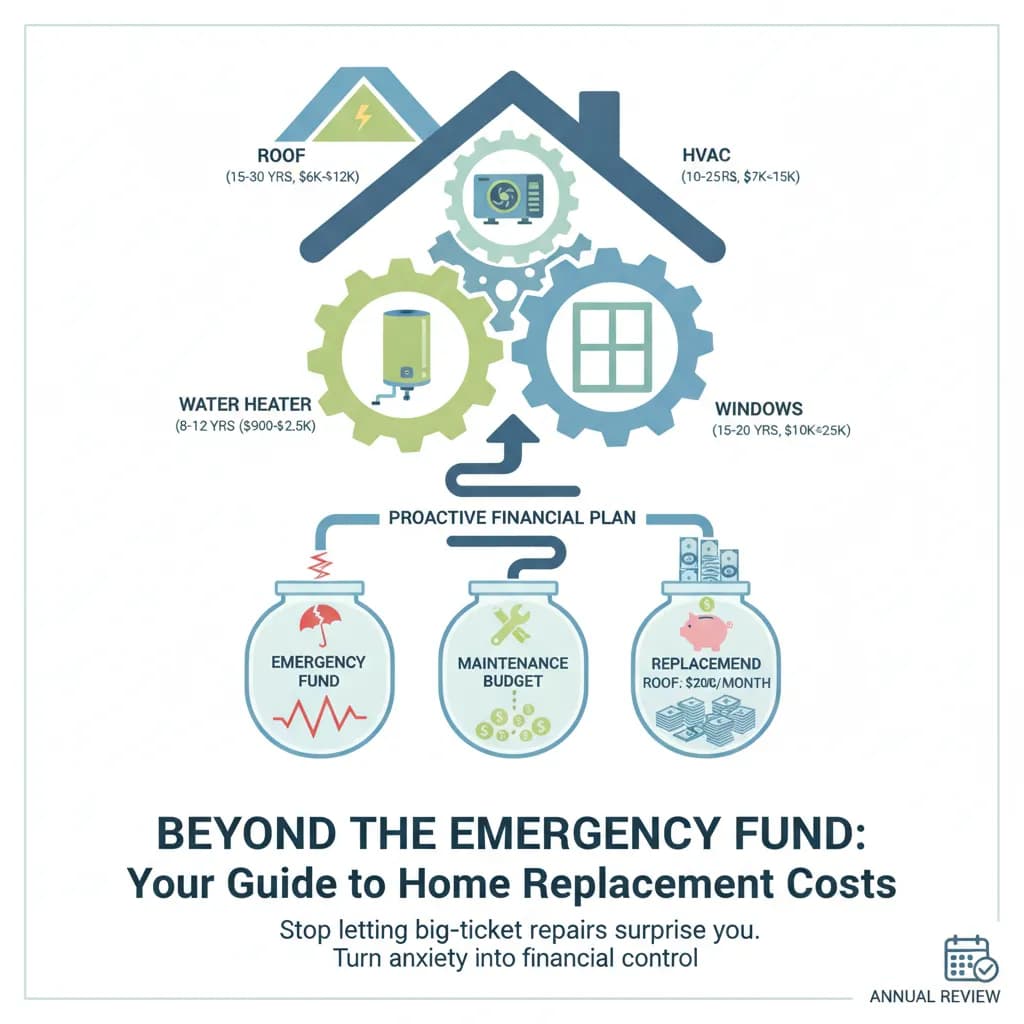
The key difference between these funds lies in their purpose: a replacement fund is for predictable, large-scale replacements; an emergency fund is for unpredictable disasters; and a maintenance budget covers routine upkeep. Confusing them can leave you financially exposed when a major expense arises. Understanding their distinct roles is fundamental to building a sound financial strategy for your home.
A replacement fund is your strategic war chest for the big, predictable battles of homeownership. You know your 20-year-old roof will need to be replaced in the next few years, and you know your 12-year-old water heater is on borrowed time. This fund is built by calculating the future cost of these items and saving for them methodically over time. It's for expenses that are inevitable but not immediate. Using this fund means you never have to panic or go into debt when a major system reaches the end of its life.
An emergency fund is for true, unforeseeable crises. This is the money you use when a tree falls on your house, a pipe suddenly bursts inside a wall causing major water damage, or you experience a sudden job loss that impacts your ability to pay your mortgage. These are events you cannot predict or plan a timeline for. This fund should be liquid, easily accessible, and cover 3-6 months of living expenses. Its purpose is to prevent a disaster from becoming a financial catastrophe. Tapping your emergency fund for a predictable furnace replacement is a misuse of the fund and leaves you vulnerable to a real emergency.
Your maintenance budget is part of your regular monthly or annual household spending, not a separate savings fund. This is the money allocated for the routine tasks that keep your home running smoothly and prevent small issues from becoming large ones. This includes costs like annual HVAC tune-ups, gutter cleaning, lawn care, replacing smoke detector batteries, pest control services, and buying new HVAC filters. These are small, recurring costs that are essential for preserving the life of your major systems, directly protecting the timeline you've set in your replacement plan.
The first step in creating a replacement plan is to conduct a thorough inventory of every major component in your home to understand what you own and its current condition. You can't plan for the future if you don't have a clear picture of the present. Grab a notebook or open a spreadsheet and walk through your home, room by room, and around the exterior. For each item, note its type, brand, and model number if available. Your home inspection report is an excellent starting point for this list, as it often details the age and condition of major systems at the time of purchase.
Your inventory should include:
To budget accurately, you must determine the current age and research the typical life expectancy for each of your home's major systems. This allows you to calculate the “remaining useful life,” which is the cornerstone of your savings plan. The age tells you where you are on the timeline, and the expected lifespan tells you where the finish line is. Combining these two data points reveals how much time you have left to save.
Look for a manufacturer's data plate on the side of both your indoor furnace/air handler and your outdoor condenser unit. This metal plate contains the model and serial number. While the installation date is rarely printed, the manufacturing date is almost always encoded within the serial number. A quick Google search for “[Brand Name] serial number lookup” will usually lead you to a guide for decoding it. For example, a serial number might start with a letter for the plant and then four digits for the week and year of manufacture (e.g., 'W1821' could mean the 21st week of 2018).
Similar to your HVAC system, your water heater has a data plate with a serial number that contains its manufacturing date. The format varies by brand, but it's very common for the first four digits to represent the month and year. For example, a serial number starting with “0520” likely means it was made in May of 2020. Again, searching online for your brand's specific format is the most reliable method.
Determining a roof's age can be trickier if you don't have records from the previous owner. You can check your seller's disclosures from when you bought the home, or look for a building permit on your local municipality's website. If those aren't available, you'll have to rely on visual inspection. Signs of an aging asphalt shingle roof include shingles that are curling at the edges, significant loss of granules (they look like coarse black sand in your gutters), cracked shingles, or dark streaks. If you see these signs, it may be worth getting a professional roofer's opinion on its remaining life.
Understanding the general lifespan and replacement cost of your home's most expensive components is the financial heart of your plan. The following figures are national averages for 2024; costs can vary significantly based on your location, the size and complexity of your home, and the quality of materials you choose. Use these as a starting point for your research.
A roof's lifespan depends almost entirely on the material, but the most common asphalt shingles typically last 15 to 30 years. Architectural or dimensional shingles are on the higher end of that range, while basic 3-tab shingles are on the lower end. A full roof replacement is a major expense, with national averages ranging from $6,000 to $12,500 for a typical asphalt shingle roof. Metal roofs, while more expensive upfront at $8,000 to $20,000+, can last 50 years or more, changing the long-term savings calculation.
Your home's heating, ventilation, and air conditioning (HVAC) system is actually two main components: the furnace and the air conditioner. Furnaces generally last longer, around 15 to 25 years, while central air conditioners typically have a lifespan of 10 to 15 years. Because they often share ductwork and components, many homeowners replace them at the same time. Replacing just the furnace can cost $3,000 to $7,500, while a new AC unit can run $4,000 to $8,000. A full HVAC system replacement averages between $7,000 and $15,000.
Traditional storage-tank water heaters have a lifespan of 8 to 12 years; if yours is over 10 years old, it's living on borrowed time. Replacement cost for a standard gas or electric tank model, including installation, typically ranges from $900 to $2,500. On-demand or tankless water heaters last much longer, often 20 years or more, but have a higher upfront cost of $2,000 to $5,500.
Siding is your home's skin, and its lifespan varies dramatically by material. Vinyl siding, one of the most common options, lasts 20 to 40 years and costs $4 to $12 per square foot to install. Fiber cement siding (like HardiePlank) is a more durable and expensive option, lasting 50 years or more but costing $6 to $15 per square foot. For a 2,000 sq. ft. home, a full siding replacement could range from $8,000 to $30,000 or more.
Modern double-pane windows typically last 15 to 20 years before the seals can fail, leading to foggy glass and loss of insulating properties. Window replacement is a significant investment, and costs are highly variable based on size, material, and style. A single vinyl replacement window can cost $450 to $850 installed, while a wood window can be $800 to $2,000. Replacing all the windows in a house can easily cost $10,000 to $25,000+.
While not part of the home's core structure, major appliances are a key part of your replacement plan. On average, you can expect a refrigerator to last 10-15 years, a dishwasher 9-12 years, and a washer and dryer set 10-14 years. Replacement costs can range from $500 to $2,500+ per appliance, depending on the model and features.
An electrical panel (or breaker box) can last 25 to 40 years, but it's often replaced for functional reasons long before it fails. If you're adding a major appliance, an EV charger, or doing a large renovation, you may need to upgrade your panel's capacity (e.g., from 100 amps to 200 amps). A panel upgrade is not a DIY job and typically costs $1,500 to $4,000.
Your driveway's lifespan depends on the material and climate. A well-maintained asphalt driveway can last 15 to 20 years, while a concrete driveway can last 25 to 30 years. Replacement is priced by the square foot, with asphalt costing $3 to $7 per sq. ft. and concrete costing $4 to $8 per sq. ft. A typical two-car driveway could cost $3,000 to $7,000 to replace.
The formula to calculate your annual savings goal for each item is: (Estimated Replacement Cost) / (Remaining Useful Life in Years) = Annual Savings Goal. This simple calculation is the engine of your replacement plan. It breaks down a daunting future expense into manageable, predictable savings targets. For example, if you estimate your roof will cost $10,000 to replace and it has 10 years of life left, your annual savings goal for the roof is $1,000 ($10,000 / 10). To get your monthly savings goal, simply divide the annual goal by 12. In this case, you would need to set aside $83.33 per month just for the roof. You'll repeat this calculation for every major item on your inventory list.
To illustrate, let's create a sample replacement plan for a fictional 10-year-old home with systems that are all original. This example demonstrates how the formula works across different components to generate a total monthly savings goal. This is a simplified table; your own will have more items.
| Component | Est. Replacement Cost | Total Lifespan | Current Age | Remaining Life | Annual Savings | Monthly Savings | | :--- | :--- | :--- | :--- | :--- | :--- | :--- | | Roof (Asphalt) | $10,000 | 25 years | 10 years | 15 years | $667 | $56 | | HVAC System | $12,000 | 15 years | 10 years | 5 years | $2,400 | $200 | | Water Heater (Tank) | $1,800 | 12 years | 10 years | 2 years | $900 | $75 | | Dishwasher | $800 | 10 years | 10 years | 0 years | $800 | $67 | | TOTAL | | | | | $4,767 | $398 |
In this scenario, the homeowner needs to save $398 per month to be fully prepared for these four upcoming replacements. The plan immediately highlights the urgency of the water heater and dishwasher, which are at the end of their lives, and the high-priority savings needed for the HVAC system.
Your home replacement fund should be kept in a separate, liquid, and interest-bearing account, like a High-Yield Savings Account (HYSA), to keep it safe, accessible, and working for you. It's critical to keep this money separate from your primary checking account to avoid accidentally spending it on daily expenses. It should also be separate from your long-term retirement investments, as you need to be able to access it without penalty when a replacement is due. An HYSA is often the perfect vehicle because it offers a much higher interest rate than a traditional savings account—allowing your fund to grow passively over time—while still keeping the money liquid and FDIC-insured.
You should review and adjust your home replacement plan annually to account for inflation, changes in component condition, and your own financial situation. A replacement plan is a living document, not a one-time setup. The financial landscape and the physical condition of your home are constantly changing, and your plan needs to adapt to remain accurate and effective.
The $10,000 you budget for a roof today will not be $10,000 in a decade. The costs of labor and materials consistently rise over time. During your annual review, research the current replacement costs for your big-ticket items and adjust your savings goal accordingly. A simple way to do this is to increase your total savings goal by 3-4% each year to keep pace with historical inflation rates for construction and services. This ensures that when the bill comes due in 5, 10, or 15 years, your savings haven't been devalued.
Sometimes, a significant repair can extend the life of a system. For example, if you spend $1,500 to replace the compressor on your 12-year-old AC unit, a professional might tell you that you've likely bought it another 3-5 years of life. In this case, you can update your plan. You would adjust the “Remaining Useful Life” for that item and recalculate your monthly contribution. This might lower your required monthly savings for the AC, freeing up cash you can redirect toward a more urgent replacement goal.
You can decide whether to repair or replace a system by using the “50% rule,” which states that if a repair costs 50% or more of the total replacement cost, you should replace it. This rule of thumb helps prevent you from throwing good money after bad. For instance, if your 14-year-old furnace (nearing the end of its 15-20 year lifespan) needs a $2,500 repair and a full replacement costs $5,000, the 50% rule would strongly suggest replacement is the more financially sound option. Another factor is the frequency of repairs. If you're calling a technician for the same appliance every year, the cumulative cost and unreliability likely mean it's time to replace it, even if each individual repair is small.
Following a consistent, proactive maintenance schedule can significantly extend the lifespan of your home's components, pushing back expensive replacement dates and saving you thousands of dollars. Maintenance is the single most powerful tool you have to influence your replacement plan. A furnace with an annual tune-up and clean filters is far more likely to reach its 25-year potential lifespan than one that is neglected. Cleaning your gutters twice a year protects your roof from water damage, extending its life. Regularly flushing your water heater removes sediment that causes corrosion and premature failure. Each of these small, low-cost tasks directly adds years to your timeline, which means more time to save and less money spent over the long run.
Use this table as a reference for your own planning. Costs are national averages for 2024 and will vary by region, home size, and material quality. The "Annual Savings Goal" assumes the component is brand new and calculates the amount to save each year over its entire lifespan.
| Component | Average Lifespan | Average Replacement Cost | Factors Affecting Lifespan | Estimated Annual Savings Goal (from new) | | :--- | :--- | :--- | :--- | :--- | | Roof (Asphalt) | 15-30 years | $6,000 - $12,500 | Climate, ventilation, maintenance | $400 - $500 | | Roof (Metal) | 50-70 years | $8,000 - $20,000+ | Quality of installation, climate | $250 - $400 | | Furnace | 15-25 years | $3,000 - $7,500 | Regular tune-ups, filter changes | $200 - $375 | | Central Air Conditioner | 10-15 years | $4,000 - $8,000 | Maintenance, climate, usage | $400 - $530 | | Water Heater (Tank) | 8-12 years | $900 - $2,500 | Water hardness, regular flushing | $110 - $210 | | Water Heater (Tankless) | 20+ years | $2,000 - $5,500 | Water hardness, descaling | $100 - $275 | | Siding (Vinyl) | 20-40 years | $8,000 - $18,000 | Sun exposure, climate, cleaning | $300 - $600 | | Windows (Vinyl) | 15-20 years | $10,000 - $25,000 (whole house) | Sun exposure, quality of seals | $650 - $1,250 | | Refrigerator | 10-15 years | $800 - $2,500+ | Cleaning coils, brand quality | $80 - $170 | | Dishwasher | 9-12 years | $500 - $1,500 | Water hardness, regular cleaning | $55 - $125 | | Washer/Dryer | 10-14 years | $1,000 - $2,500 (pair) | Load size, maintenance | $100 - $180 | | Electrical Panel | 25-40 years | $1,500 - $4,000 (upgrade) | Load, moisture, brand | $60 - $100 | | Driveway (Asphalt) | 15-20 years | $3,000 - $7,000 | Sealing, climate, soil stability | $200 - $350 | | Deck (Wood) | 10-25 years | $5,000 - $15,000 | Sealing/staining, climate | $400 - $600 |
Is the 1% rule enough for replacement costs? The 1% rule, which suggests saving 1% of your home's value annually for maintenance, is a good starting point but often falls short of covering major replacements. For a $400,000 home, this is $4,000/year. As our sample plan showed, just a few aging systems can easily require more than that, and this doesn't even include routine maintenance costs. A personalized plan based on the actual age and condition of your components is far more accurate.
Should I use a home warranty instead of a replacement fund? A home warranty is not a substitute for a replacement fund. Warranties are service contracts that may cover repairs or replacements for a fee, but they come with many exclusions, limitations, and contractor choices you don't control. A replacement fund gives you total control over the quality of the new component and the installer, and it's there for you no matter what. Many homeowners use both, relying on the warranty for smaller repairs while the replacement fund grows for the inevitable full replacement.
Can I use a HELOC or loan for a replacement? Yes, you can use a Home Equity Line of Credit (HELOC) or a personal loan, but this means you will be paying interest on the replacement, making it more expensive in the long run. A dedicated replacement fund allows you to pay for the expense with cash, avoiding debt and interest charges. Using loans should be a backup option, not the primary plan.
Does replacing a major system increase my home's value? Not always. Replacing a 25-year-old roof with a new one doesn't necessarily add $10,000 to your sale price; it simply meets the basic expectation of a functional roof. Buyers expect a working furnace and a roof that doesn't leak. While new, high-efficiency systems can be a selling point, most replacements are about preserving your home's value and preventing it from decreasing due to neglect, rather than actively increasing it.
Reading through this guide, you might be thinking this process sounds like a lot of work. Creating spreadsheets, hunting for serial numbers, researching costs, and constantly updating your calculations is a significant commitment.
This is precisely why we built Properteer.
The days of manual tracking and financial guesswork are over. Properteer is a digital platform designed to be your home's new brain. It helps you create a digital twin of your home, automatically identifying your major appliances and systems. The app tracks their age, predicts their lifespan based on real-world data, and builds a dynamic, personalized financial plan for you.
Instead of building a spreadsheet, you build a digital fortress. Properteer will:
Stop dreading the inevitable. Start planning for it. Visit Properteer.ai to see how you can take control of your home's financial future today.
What is a home replacement fund? A home replacement fund is a dedicated savings account, separate from an emergency fund, used to pay for the eventual replacement of major home systems like your roof, HVAC, and water heater.
How is a replacement fund different from an emergency fund? A replacement fund is for predictable expenses (e.g., a 15-year-old AC unit failing), while an emergency fund is for unpredictable disasters (e.g., a tree falling on your house).
How do I calculate how much to save? Use the formula: (Estimated Replacement Cost) / (Remaining Years of Lifespan) = Annual Savings Goal. Do this for every major component and add the results together for your total annual savings target.
What's the best place to keep my replacement fund? A High-Yield Savings Account (HYSA) is ideal because it keeps your money safe, is easily accessible, and allows the fund to grow with a competitive interest rate.
When should I repair an item versus replacing it? A good rule of thumb is the 50% rule: if a repair costs 50% or more of a full replacement, it's generally better to replace the item, especially if it's near the end of its expected lifespan.