Posted On: Jul 16, 2026
Author: Jason H.
condo-living hoa-maintenance homeowner-finances
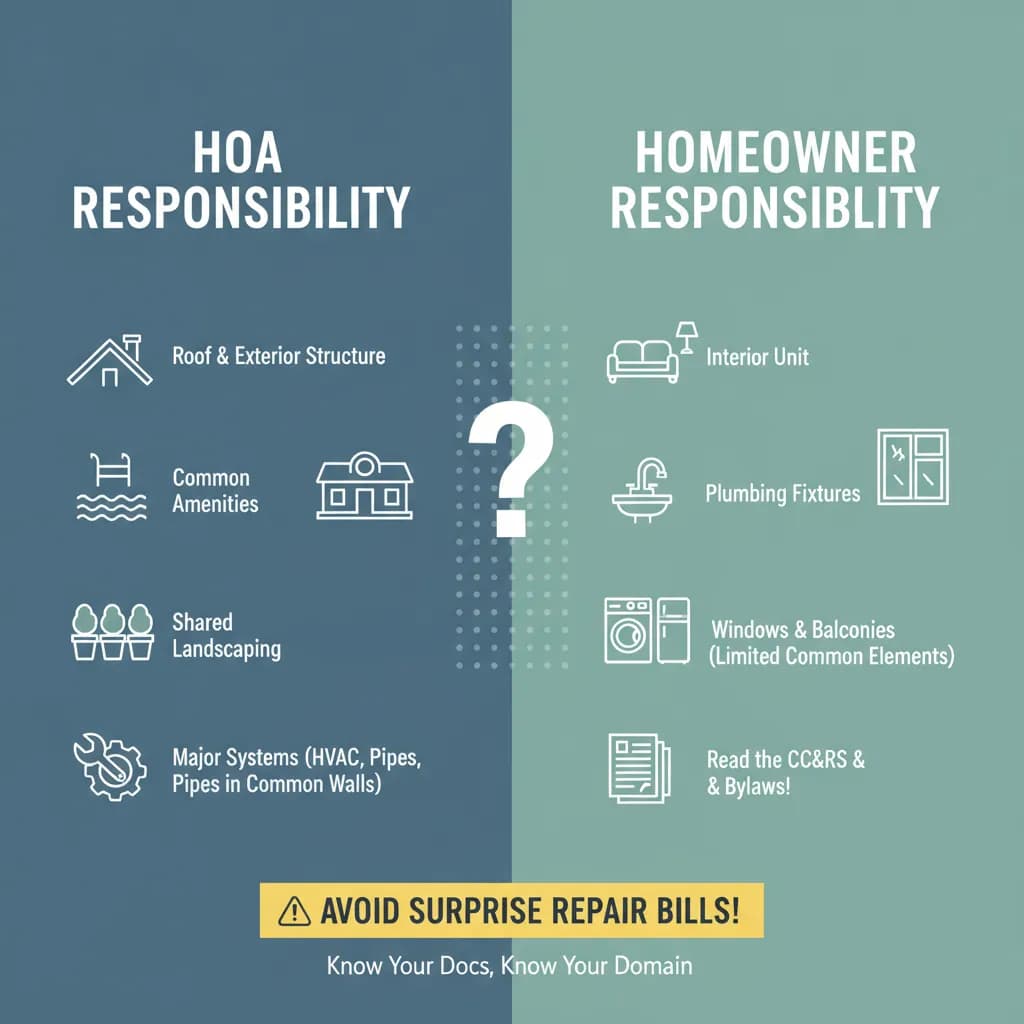
One of the biggest selling points of living in a condominium or a neighborhood with a Homeowners Association (HOA) is the promise of low-maintenance living. Someone else mows the lawn, shovels the snow, and worries about replacing the roof. It sounds perfect, especially for a first-time homeowner.
But then a window seal fails, a pipe inside a shared wall starts to drip, or your A/C condenser unit on the roof stops working. You assume the HOA will handle it, but you get an email back saying the five-figure repair bill is all yours. Suddenly, the dream gets complicated.
Understanding the line between your responsibility and the association's is one of the most critical—and most confusing—parts of HOA life. Getting it wrong can cost you thousands.
Every HOA has a set of legal documents that are the ultimate authority on who is responsible for what. Stop guessing and start reading. The two most important documents are:
These documents can be dense, but the maintenance section is your financial bible. Look for keywords like “maintenance,” “repair,” “replacement,” and “owner responsibility.”
Most HOAs operate on a principle often called “walls-in” or “studs-in.” While the specifics vary, the general idea is this:
The HOA is typically responsible for:
You are typically responsible for:
This seems straightforward, but the real trouble starts in the gray areas.
Limited Common Elements (LCEs) are parts of the property outside your unit but designated for your exclusive use. This is where most expensive disputes happen.
Even when the HOA is responsible for a major repair, like a new roof, it doesn’t mean you’re off the hook. If the association hasn’t saved enough money in its reserve fund, it will issue a “special assessment.”
This is a one-time fee levied on every owner to cover the budget shortfall. It can range from a few hundred dollars to a staggering $20,000 or more, often with little warning. A healthy reserve fund is the sign of a well-run HOA; a history of special assessments is a major red flag.
Living in an HOA simplifies some things, but it adds a new layer of financial complexity. While the association worries about the roof and the lawn, you still have a whole home’s worth of systems and appliances inside your walls to manage.
That's where Properteer comes in. Properteer helps you track the age and health of everything the HOA doesn’t cover—your water heater, furnace, dishwasher, and more. Our platform helps you understand the expected lifespan of these components and create a simple, automated savings plan for their eventual replacement. You can’t control when the HOA will levy an assessment, but you can be fully prepared for your own responsibilities.
Don’t get blindsided. Use Properteer to turn your personal maintenance to-do list from a source of stress into a clear, actionable plan.
Q: Where can I find out exactly what my HOA covers? A: Your association’s governing documents are the only official source. Specifically, look for the Covenants, Conditions & Restrictions (CC&Rs), which will define owner vs. association maintenance responsibilities.
Q: What is a “limited common element”? A: It’s an area outside your personal unit that is for your exclusive use, such as a balcony, patio, or assigned parking spot. Repair responsibility for these areas varies widely and should be clearly defined in your CC&Rs.
Q: My upstairs neighbor's washing machine leaked and damaged my ceiling. Who pays? A: This is a complex situation that depends on your HOA rules and insurance policies. Generally, your neighbor is responsible for the source of the leak (their machine), and you are responsible for the repairs inside your unit (your ceiling). This is where your homeowner's insurance (and theirs) becomes critical.
Q: What is a special assessment? A: A special assessment is a fee charged to every homeowner in the association to cover a large, often unexpected, expense that the HOA’s reserve fund cannot handle. This is often for major capital projects like a full roof replacement, repaving of roads, or major structural repairs.
