Posted On: Jul 19, 2026
Author: Jason H.
budgeting home-maintenance financial-planning
So you've signed the papers, gotten the keys, and you're officially a homeowner. Congratulations! Amidst the excitement of picking out paint colors and arranging furniture, a nagging question often surfaces: How much should I actually be saving for repairs and maintenance?
If you've spent any time searching for an answer, you've almost certainly come across the “1% Rule.”
In short, the 1% rule suggests that you should budget 1% of your home's purchase price for annual maintenance and repairs. So, for a $400,000 home, you'd set aside $4,000 per year, or about $333 per month.
It's simple, easy to remember, and it’s a fantastic starting point for getting new homeowners to think beyond their monthly mortgage payment. It acknowledges the crucial truth that owning a home costs more than just principal, interest, taxes, and insurance. But here’s the problem: for many homes, it’s not nearly enough.
The 1% rule is a useful guideline. It forces you to create a line item in your budget for your home's health, preventing you from being completely blindsided when the water heater inevitably gives out. It’s a good mental anchor.
However, a home isn’t a spreadsheet. It’s a complex system of components exposed to real-world conditions. Relying solely on a simple percentage can leave you financially vulnerable. Here’s why:
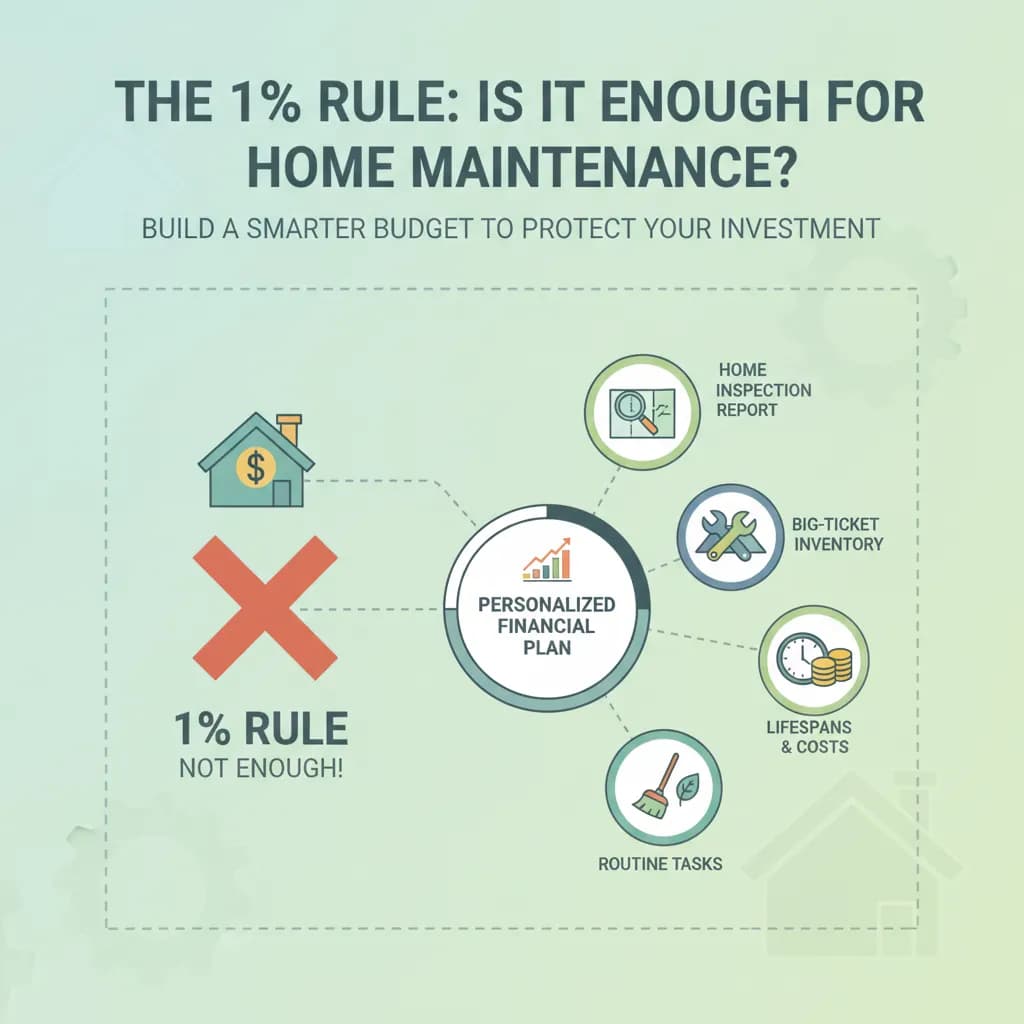
So, how do you move beyond the 1% guess and create a budget that reflects the reality of your home? You need to get specific.
That thick document you received before closing is your single best roadmap for the first 1-3 years. It's a professional assessment of your home's major systems. Go through it again and create a list of items marked as “nearing end of life,” “in need of service,” or “monitor.” This is your immediate priority list.
List every major component of your home and its approximate age. If you don't know the exact age, look for manufacturing dates on the units themselves.
For each item on your list, do a quick search for its average lifespan and a ballpark replacement cost in your area. This will feel like a lot of work, but understanding that your 12-year-old AC unit (average life: 15 years) might cost $7,000 to replace soon is a powerful motivator to save.
Divide the replacement cost by the number of years you have left. That's how much you should be saving for that one item each year.
Example:
Finally, add in the cost of predictable, annual maintenance like gutter cleaning, HVAC tune-ups, pest control, and chimney sweeping. These are your operational costs.
Your true budget is the sum of your annual routine tasks plus the amount you need to set aside for all your future big-ticket replacements. For most, this number is a sobering wake-up call and often much higher than 1%.
Feeling overwhelmed? That's normal. Manually tracking the age, condition, and replacement cost of every component of your home is a massive, ongoing project. It's exactly why so many people get caught by surprise when a major system fails.
This is where Properteer transforms the process. Instead of building messy spreadsheets and guessing at costs, Properteer uses AI to create a personalized financial forecast for your specific home. It identifies your home’s core components, tracks their expected lifespans, and builds a dynamic capital plan so you know exactly what to save for and when.
Stop relying on a generic rule of thumb. With Properteer, you can turn confusion into confidence, creating a precise, data-driven budget that protects your biggest investment. Learn more about how Properteer can help you plan for the true cost of homeownership.
Q: What is the 1% rule for home maintenance? A: The 1% rule is a common guideline that suggests homeowners should budget 1% of their home's value for maintenance and repairs each year. For a $400,000 home, this would be $4,000 annually.
Q: Is the 1% rule accurate for every home? A: No. While it's a good starting point, it's often too simplistic. The age of your home, local climate, and its previous maintenance history can significantly increase your actual costs, sometimes to 2-4% of the home's value.
Q: What factors make home maintenance more expensive than the 1% rule suggests? A: Key factors include: an older home (over 20-30 years), a location with harsh weather (heavy snow, hurricanes, extreme heat), a history of deferred maintenance from previous owners, and living in a high-cost area where labor and materials are more expensive.
Q: How can I create a more accurate home maintenance budget? A: Start by reviewing your inspection report for immediate needs. Then, inventory all your major systems (roof, HVAC, water heater), estimate their remaining lifespan and replacement costs, and calculate how much you need to save for each annually. Don't forget to add in the cost of routine yearly tasks like gutter cleaning and system tune-ups.
