Posted On: Sep 23, 2026
Author: Jason H.
deferred maintenance home budget homeowner tips
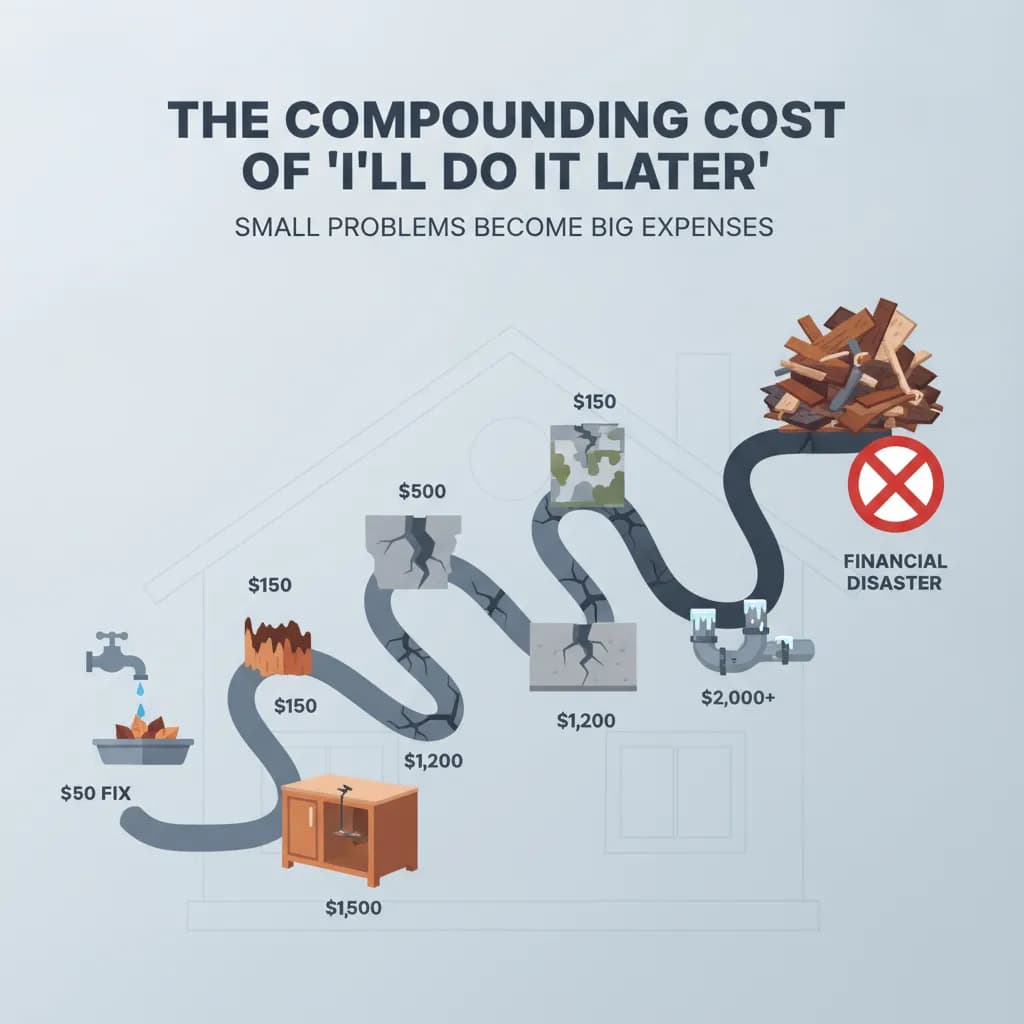
That little patch of peeling paint on the window trim. The gutter that’s pulling away from the roof just an inch. The faint, musty smell in the basement after a heavy rain. As a homeowner, you have a mental list of these “I’ll get to it later” tasks. It’s not laziness; it’s a defense mechanism against a to-do list that feels a mile long.
But here’s the hard truth: Deferred maintenance is a high-interest loan you take out against your home's future. Every small problem you postpone doesn’t just wait patiently; it actively works against you, compounding over time into a financial disaster.
Your home is an interconnected system. A failure in one small part puts stress on others, creating a domino effect that can wreck your budget. Let's look at how quickly “later” gets expensive:
The Problem: A clogged gutter.
The “Later” Cost: It’s just a few leaves, right? But during the next downpour, water sheets over the edge and soaks the wooden fascia board behind it. The wood begins to rot. Water pools against your foundation. In the winter, that water freezes and expands, creating a hairline crack in the concrete. A few years later, you’re not just cleaning gutters; you’re replacing rotted wood, sealing a foundation crack, and dealing with water in your basement.
The Problem: A small, dripping leak under the kitchen sink.
The “Later” Cost: You put a bowl under it. But the constant dampness seeps into the cabinet floor, warping the particleboard. Mold begins to grow in the dark, damp space. The moisture wicks into the subfloor, causing it to swell and weaken. Before you know it, you're not just replacing a faucet gasket; you're ripping out a cabinet, replacing a section of subfloor, and paying for mold remediation.
The contractor's invoice is only part of the story. Deferred maintenance bleeds money from your budget in ways you might not even notice.
Higher Utility Bills: That drafty window you never re-caulked? It’s forcing your HVAC system to work overtime, month after month. The same goes for poor attic insulation, an un-serviced furnace, or a water heater caked with sediment. These small inefficiencies add up to hundreds of dollars a year in wasted energy.
Decreased Home Value: Home inspectors and appraisers are trained to spot neglect. Peeling paint, cracked driveways, and signs of water intrusion are giant red flags. These issues don’t just lead to repair requests from buyers; they can significantly lower your home’s appraised value, eroding the equity you’ve worked so hard to build.
Insurance Complications: If a pipe bursts and floods your basement, insurance will likely cover it. But if the insurance investigator finds that the pipe had been slowly leaking for months—a problem you knew about but ignored—your claim could be denied on the grounds of negligence.
Serious Safety Hazards: This is the most critical cost. A flickering light that’s ignored could be a sign of a faulty wire, a major fire risk. A rickety deck board you meant to replace could cause a serious injury. Proactive maintenance isn’t just about money; it’s about protecting your family.
Shifting from a reactive to a proactive mindset is the single most important thing you can do as a homeowner. It’s not about having more time or money; it’s about having a plan.
The chaos of homeownership—the endless list of tasks, the surprise repairs, the nagging worry about what might break next—is overwhelming. But what if you had a system to manage it all? A way to know what needs to be done, when it needs to be done, and how to budget for it?
That's exactly why we built Properteer. Instead of letting small issues fester, Properteer helps you create a customized maintenance plan for your specific home. It sends you smart alerts for critical tasks, so you never forget to clean the gutters or service the furnace again. More importantly, it helps you build a long-term financial forecast, so you can confidently save for big-ticket replacements like a new roof or water heater. Stop letting “later” rob you of your home’s value and your peace of mind. Take control with a plan.
Q: What exactly is deferred maintenance?
A: Deferred maintenance is the practice of postponing necessary repairs and upkeep on your home. It’s choosing to put off a small, manageable task today, which often allows it to grow into a large, expensive problem tomorrow.
Q: Why is putting off small repairs so expensive?
A: Because homes are systems. A single ignored issue, like a small leak, can cause a chain reaction of damage to surrounding materials like wood, drywall, and subflooring, and can lead to secondary problems like mold. This turns a simple fix into a complex, multi-part repair job.
Q: How can I start tackling my home's deferred maintenance?
A: Start by doing a thorough walk-through of your home, inside and out, and make a list of every issue you see. Prioritize the list based on 1) Safety (electrical, structural) and 2) Potential for water damage (roof, gutters, plumbing). Then, create a budget and a timeline to tackle the items one by one.
Q: How much should I really be saving for home maintenance?
A: A good starting point is to save 1-3% of your home's value each year. However, a more accurate budget will depend on the age, condition, and location of your home. Using a tool like Properteer can help you create a personalized budget based on the expected lifespan of your home's major components.