Posted On: Oct 14, 2026
Author: Jason H.
appliances budgeting home-maintenance
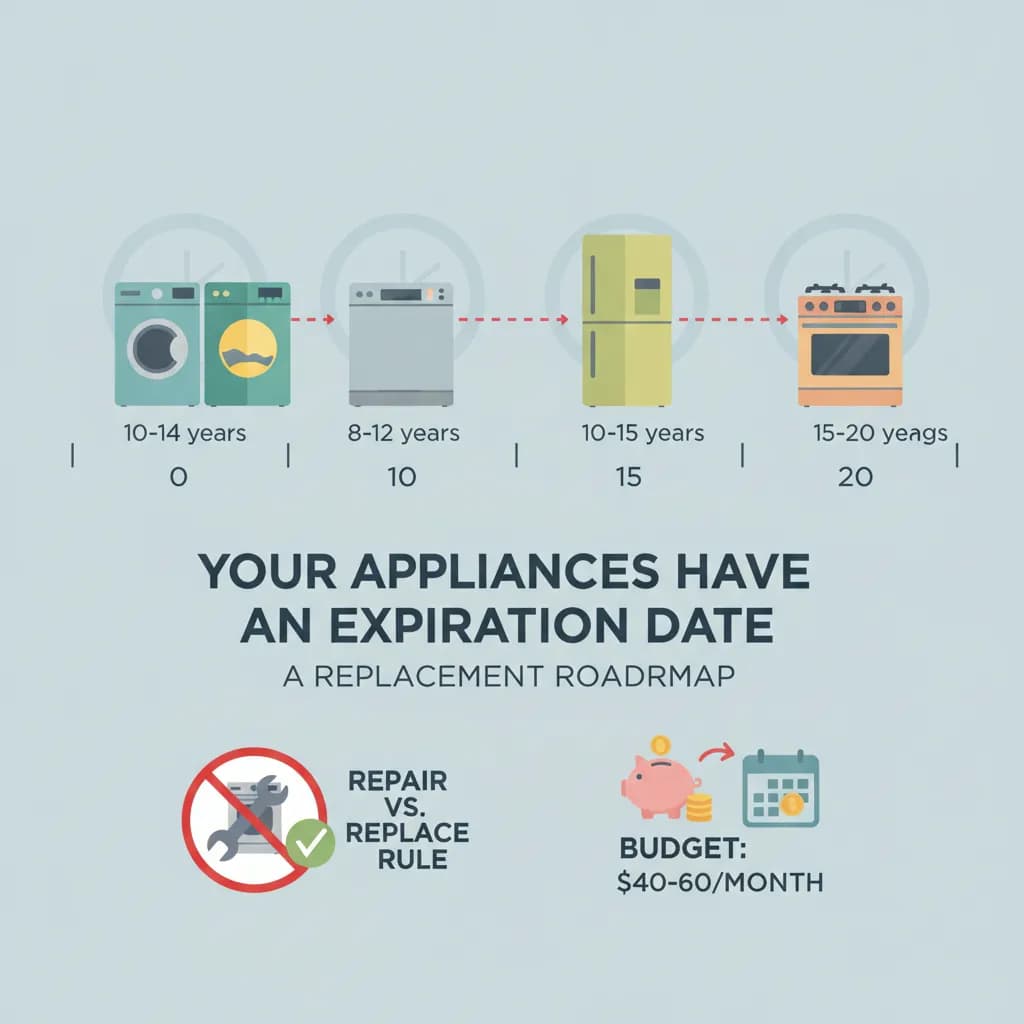
It happens when you least expect it. You come home to a puddle on the kitchen floor, courtesy of a suddenly deceased dishwasher. Or the washing machine, mid-cycle with your work clothes, gives up the ghost with a final, shuddering groan. These moments aren't just inconvenient; they can deliver a major blow to your budget.
As a homeowner, especially a new one, it's easy to focus on the big-ticket items like the roof and the furnace. But the workhorses of your home—the appliances you rely on every single day—have their own ticking clocks. Understanding their typical lifespan is the first step in moving from panicked reaction to proactive planning.
Before we dive into specifics, let's talk about the big question: Is it worth fixing? A great rule of thumb is the 50% Rule.
It's simple: If an appliance is more than halfway through its expected lifespan, and the cost of repair is more than 50% of the cost of a new, comparable model, you should replace it.
Think of these numbers as a roadmap, not a guarantee. With great maintenance, you might beat the average. With neglect, you could fall short. Here’s a look at what you can generally expect from your major appliances.
Knowing these lifespans allows you to create an Appliance Replacement Fund. Look at the age of your current appliances. If your dishwasher is 9 years old, you know you should start setting money aside now.
A simple strategy is to add up the estimated replacement cost of your major appliances and divide by their average lifespan. This gives you a rough annual savings target. For a typical home, setting aside $40-$60 a month specifically for appliance replacement can turn a future crisis into a manageable event.
Trying to remember the age of your dishwasher, the last time you cleaned the fridge coils, and how much a new dryer will cost feels like a full-time job. This is exactly why we built Properteer.
Properteer is your home's digital brain. You can log every major appliance, its purchase date, and its model number. We use that information to automatically track its age against its expected lifespan, so you know what’s approaching its expiration date. Our platform helps you build a personalized home budget that includes planning for these inevitable replacements, transforming financial anxiety into homeowner confidence.
Stop guessing and start planning. Let Properteer help you manage your home’s most important assets, so you’re never caught by surprise again. Learn more at Properteer.ai.
Q: What is the '50% Rule' for appliance repair? A: The 50% Rule is a guideline to help you decide whether to repair or replace an appliance. If the appliance is more than halfway through its lifespan and a repair costs 50% or more than a new replacement, it's generally more cost-effective to replace it.
Q: Which major home appliance typically lasts the longest? A: Gas ranges and stoves generally have the longest lifespan, often lasting between 15 and 20 years with proper care.
Q: What's the best way to make my appliances last longer? A: Regular, simple maintenance is key. This includes cleaning refrigerator coils, clearing dishwasher filters, not overloading your washing machine, and cleaning your dryer vent line annually. Following the manufacturer's care instructions is always the best practice.
Q: How much should I budget for appliance replacement each year? A: A good starting point is to save around $500-$700 per year, or $40-$60 per month. This creates a dedicated fund so that when an appliance inevitably fails, the cost is covered without derailing your primary budget.