Posted On: Jul 13, 2026
Author: Jason H.
foundation-repair home-inspection structural-issues
You’re in the basement or walking around your house and you spot it: a crack snaking across the concrete foundation. Your heart sinks. Visions of collapsing walls and astronomical repair bills flash through your mind. For any homeowner, especially a new one, discovering a foundation crack can be terrifying.
But take a deep breath. While some cracks are indeed red flags for serious trouble, many are perfectly normal, harmless results of a house settling into its new life. The key isn't to panic; it's to understand what you're looking at. This guide will empower you to become a foundation detective, so you can tell the difference between a minor cosmetic issue and a genuine cry for help from your home.
No house is perfectly static. The ground beneath it shifts, swells, and shrinks with changes in moisture and temperature. This process, called settling, is a normal part of a home's lifecycle, especially in the first few years after construction. As the massive weight of your house settles onto the soil, the concrete foundation can develop small cracks as it adjusts. This is often no more concerning than the fine lines that appear on a leather sofa as it breaks in.
The problems begin when this movement is excessive or uneven, often due to poor drainage, soil expansion, or even tree roots. That's when you need to pay close attention.
Inspecting your foundation doesn't require special equipment. Just grab a bright flashlight and a ruler or tape measure. Do a slow walk around your home’s exterior and in your basement or crawlspace at least twice a year.
Here's what to look for:
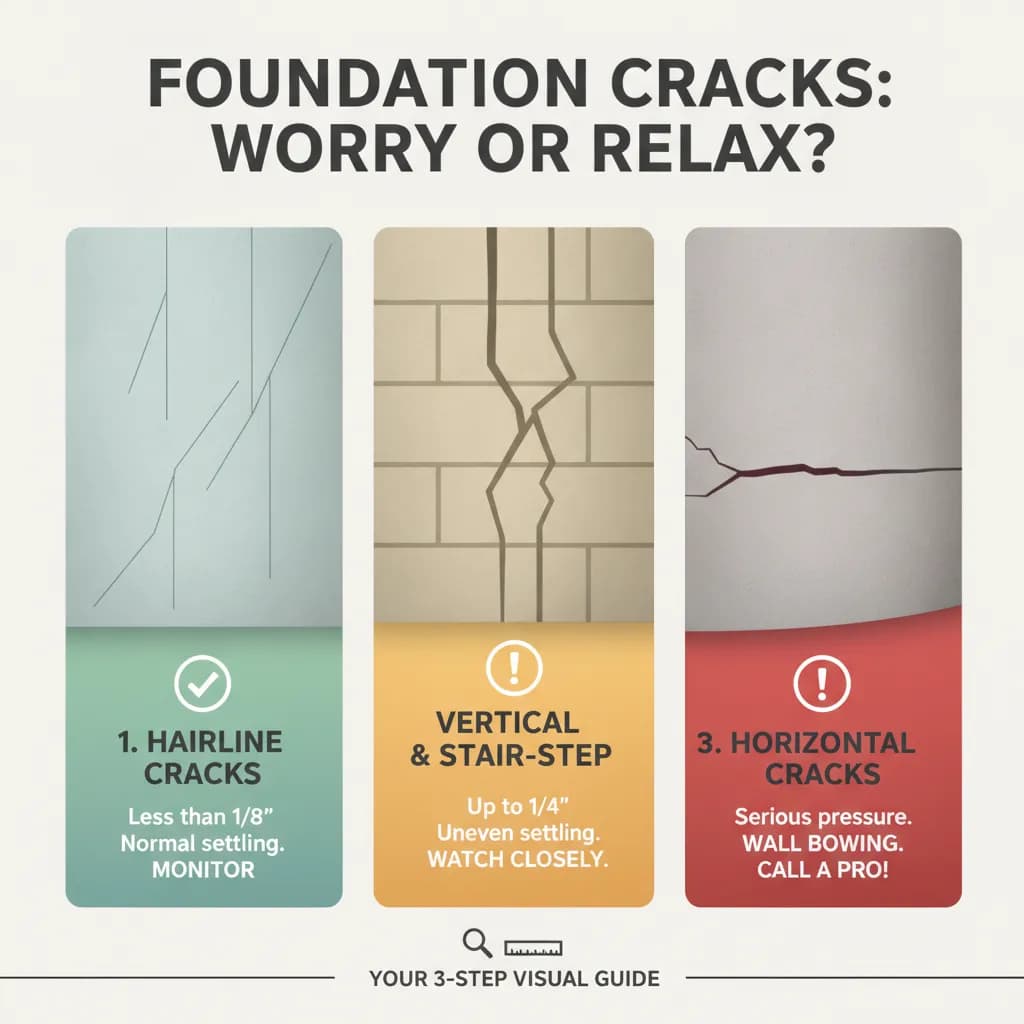
These are the tiny, thin cracks you might see in a poured concrete wall or in the mortar joints between concrete blocks. They are typically less than 1/8 inch wide.
Vertical cracks run straight up and down, while stair-step cracks follow the mortar lines in a zig-zag pattern on a block or brick foundation.
This is the one you can't ignore. A horizontal crack running across a basement or crawlspace wall is a serious warning sign.
Sometimes your foundation sends signals through other parts of the house. Look for these corroborating clues:
Being an observant homeowner is your best defense. By knowing what to look for, you can catch foundation issues while they're still manageable. For minor cracks, the plan is simple: monitor. For the red flags, the plan is equally simple: call a pro. Ignoring the problem will only make it more extensive and expensive to fix down the road.
Keeping track of your home's health, from the foundation up to the roof, can feel overwhelming. You have to remember what to check, when to check it, and what you saw last time. That's where Properteer comes in.
Properteer helps you build a custom maintenance plan for your entire home, including quarterly reminders to walk your foundation and check for changes. You can log photos of cracks right in the app to track their progress over time and use our budgeting tools to plan for potential repairs long before they become an emergency. Stop guessing and start taking control of your home's long-term health. Visit Properteer.ai to see how you can build a smarter, stress-free ownership plan from the ground up.
Q: Are all foundation cracks bad?
A: No. Thin, vertical hairline cracks (less than 1/8 inch wide) are often a normal part of a house settling and the concrete curing process. The key is to monitor them for any changes in width or length over time.
Q: Which type of foundation crack is the most serious?
A: Horizontal cracks are the most concerning. They typically indicate significant pressure from the soil or water outside the foundation wall, which can lead to bowing and structural failure. These should always be evaluated by a professional.
Q: What should I do if I find a crack in my foundation?
A: First, identify its type (vertical, horizontal, stair-step) and measure its width. For small hairline cracks, mark the ends and monitor them every few months. For any horizontal crack or any crack wider than 1/4 inch, it's best to consult a structural engineer or foundation repair company for an expert opinion.
Q: Can I fix foundation cracks myself?
A: Small, non-structural hairline cracks can sometimes be sealed with epoxy injection kits to prevent water seepage. However, any crack that is structural in nature requires professional repair to address the underlying cause, not just the symptom.
